Why You Feel Worse After a Vacation: What Makes Rest Actually Restore
2026.08.21
You finally went away, and two days back you feel exactly as you did before. "I rested—so why am I not rested?" There's a reason, and a way to change the next one.
Day three back, already drained
Monday's inbox lands all at once. The beach photo from last week already feels far away, and the first thought is "how do I make it to the next one?"
Then the self-blame: "I spent the money and the time. Do I just not know how to rest?"
You do. Vacation effects fading fast is a well-documented finding—and inside it is the hint for making the next one work.
Vacation effects genuinely don't last
The old conclusion: back to baseline in 2–4 weeks
A 2009 meta-analysis of seven studies found clear benefits for health and well-being—but most of the effect disappeared within 2–4 weeks of returning to work (de Bloom et al., 2009).
Newer studies disagree on the numbers
Two recent meta-analyses reached different conclusions.
A 2024 reanalysis of 13 studies (1,428 people, average vacation 11 days) found improvements in positive affect, stress, and exhaustion—but no significant difference from pre-vacation levels after the first week back (Speth et al., 2024).
A 2025 meta-analysis of 32 studies found the opposite: effects are larger and last longer than previously estimated, taking an average of 21 days—and up to 43 days—to return to baseline (Grant et al., 2025).
Two things they agree on
- The effect always fades. No single vacation carries a year.
- What you did matters more than how long it lasted. Both point to vacation experiences, not duration, as the driver.
The second one is the useful part—it's what we can change.
🌿 The "how" makes the recovery
1. Psychological detachment is the strongest factor
In the 2025 meta-analysis, the two biggest contributors to well-being were psychological detachment and physical activity (Grant et al., 2025).
Detachment isn't distance. It's stopping the thinking about work. Flying six hours and checking Slack from the resort isn't detachment. Three days at home without opening a work app might be better recovery.
- Turn off work notifications before you leave; log out if you can
- If you can't fully unplug, set a time: "once a day, 8 PM." Far better than all-day monitoring
- Hand off properly before you go—unfinished threads keep running in your head
2. Recovery has four parts
A 2007 recovery-experience measure distinguishes four ways people recover from work (Sonnentag & Fritz, 2007):
- Detachment — getting out of work thoughts
- Relaxation — releasing physical and mental tension
- Mastery — learning or accomplishing something unrelated to work
- Control — deciding yourself what happens when
Two of these are counterintuitive.
Mastery looks like the opposite of rest, but it helps. Navigating an unfamiliar city or learning to surf—small unrelated accomplishments ease the depleted feeling.
Control explains why some trips exhaust you. A minute-by-minute package itinerary leaves no sense of control, so it doesn't feel like rest.
Look back at your vacation. How many of the four were there? If it was only transit and photos, of course you're tired.
3. Short and frequent beats one long trip
In the 2024 meta-analysis, vacation length did not drive effect size, so the recommendation was regular short vacations across the year rather than one long block (Speth et al., 2024).
To be fair: the 2025 analysis found longer vacations produced larger benefits—but also a steeper decline afterward (Grant et al., 2025).
Together: you don't need to give up long trips, but spending all your leave in one block is inefficient. Treat a three-day weekend as a real recovery opportunity.
4. Leave a buffer day
Flying home and going straight to work carries travel fatigue into the job. One day at home to unpack and catch up on sleep softens the re-entry considerably.
If the vacation is already over
What helps now isn't planning the next trip—it's small recovery inside ordinary days.
The four elements work on a daily scale: 30 minutes after work with no work apps (detachment), stretching before bed (relaxation), an hour on something you wanted to learn (mastery), a Sunday morning with no plans (control).
Getting through re-entry with CounselCat
The hard part right after returning is that this feeling is awkward to voice. "I'm struggling since my vacation" sounds ungrateful—especially to coworkers.
That's where CounselCat (상담냥), an AI counseling app, fits:
- Anonymous, no sign-up — say "I came back from vacation and I'm low" without managing anyone's reaction
- 24/7 — including the dread the night before returning
- On-device storage — work talk stays with you
- Listening first — it sits with the flatness instead of "but it must have been nice!"
Ways to use it during re-entry:
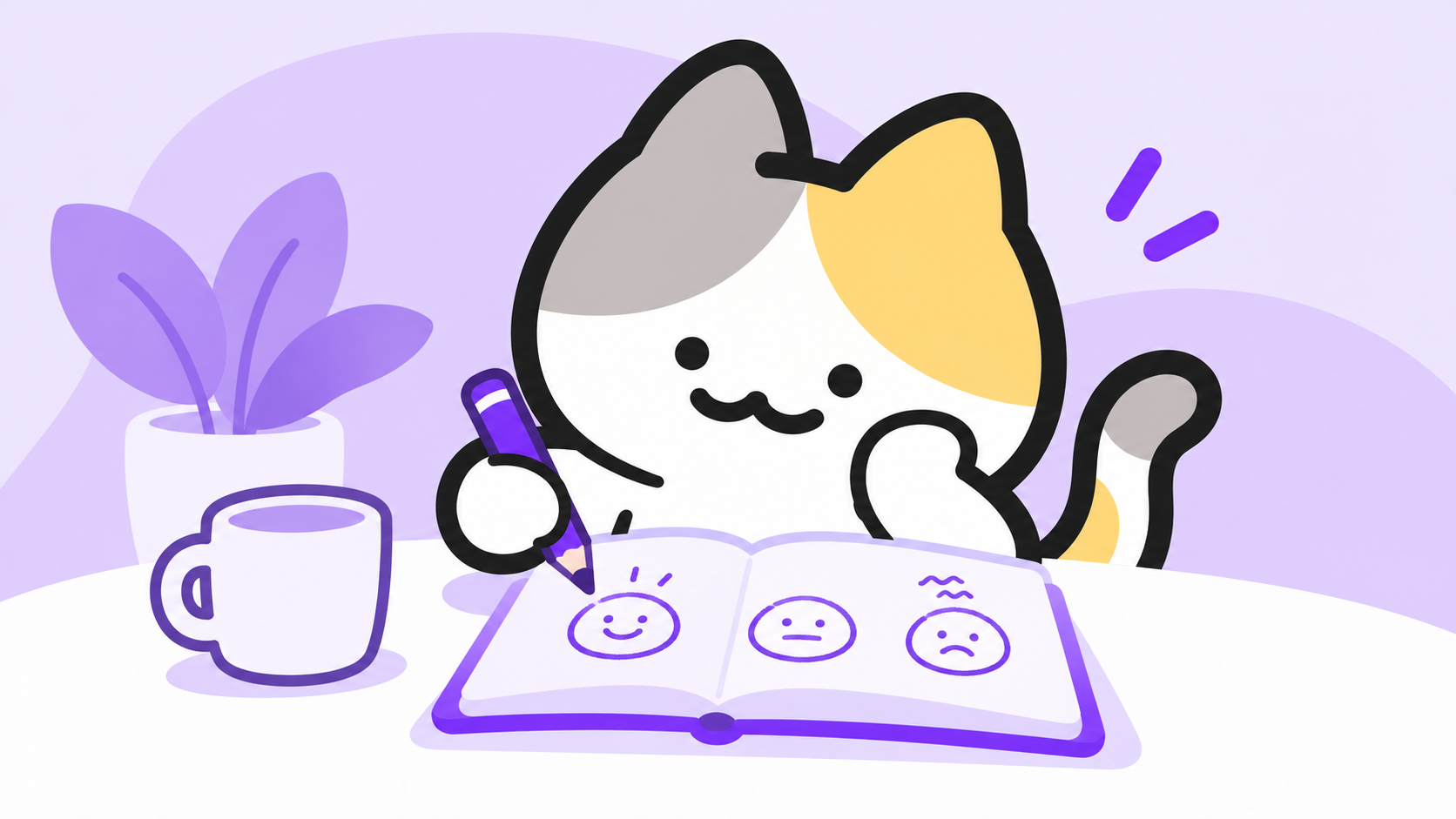
- Find your recovery pattern: log mood before and after the trip in the diary feature. When planning the next vacation, records beat memory for which trips actually restored you.
- Talk through the four elements: it's hard to judge alone which of detachment, relaxation, mastery, or control was missing. Describing the trip surfaces it.
- Short and frequent: five minutes a day through the first week back is enough.
- Pick a cat: Coco for comfort, Leo for sorting out what's next.
Starting with "vacation's over and I feel low" is enough.
If it doesn't lift after two weeks
Post-vacation flatness is common and usually settles within a week or two.
But if for 2+ weeks you dread work, feel cynical about it, and rest doesn't restore you, this may not be about the vacation. That's a signal for burnout, which vacations don't fix—it points at the volume and shape of the work itself.
See a psychiatrist or counselor. CounselCat helps in the time before and between those sessions.
AI counseling is not medical care.
Closing
A vacation feeling short isn't a sign you rest wrong. That's how vacation effects work.
So what matters isn't how long you book next time—it's how far you got from thinking about work. Closing your work apps for 30 minutes tonight is the same mechanism. One step makes this week lighter.
References
- de Bloom, J., et al. (2009). Journal of Occupational Health, 51(1), 13–25.
- Speth, F., Wendsche, J., & Wegge, J. (2024). European Psychologist, 28(4), 274–287.
- Grant, R. S., Buchanan, B. E., & Shockley, K. M. (2025). Journal of Applied Psychology, 110(7), 887–905.
- Sonnentag, S., & Fritz, C. (2007). Journal of Occupational Health Psychology, 12(3), 204–221.